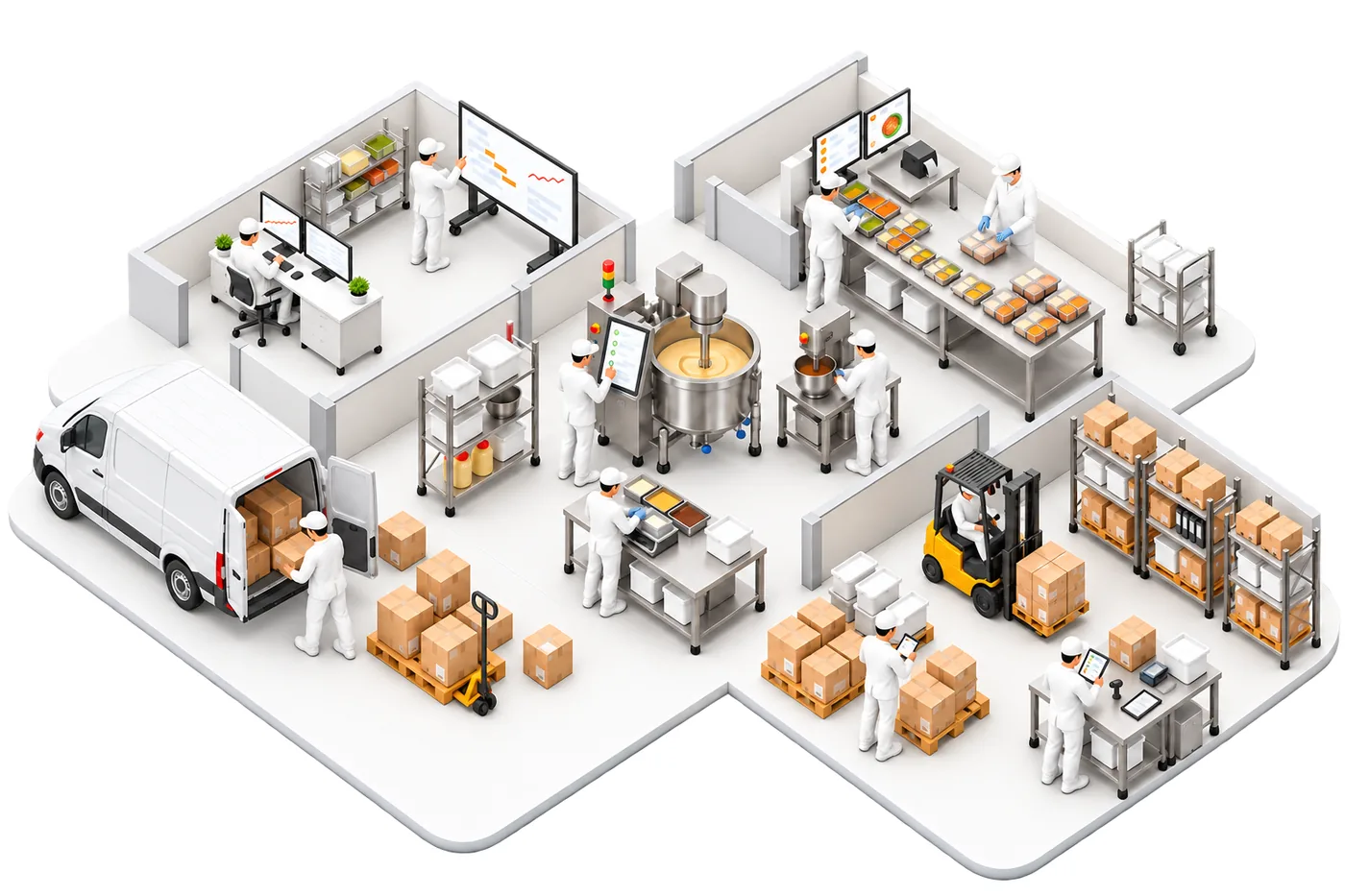
How we built and adapted a connected operating system for Rekeep's hospital meal production: from recipe and demand forecast through purchasing, warehouse and production to packing and analytics.
We analyzed and mapped how operations actually run across Rekeep's entire foodservice ecosystem.
02
Target model design
We designed the target operating processes and the system architecture behind them.
03
Building and adapting the modules
We built every module described here and fitted it to Rekeep's processes.
We built the system around Rekeep's real processes, not as a generic product shown to a client. Some figures, KPIs and the scope of supplier integrations are still awaiting confirmation by the client.
Client context
One of the largest hospital foodserviceecosystems in Poland
Rekeep serves roughly 200 hospitals through a network of central and finishing kitchens. Clinical nutrition, production, purchasing, warehouse and logistics teams carry the delivery every day.
At this scale, even small differences in recipes, planning, purchasing or deliveries turn into real cost, waste and extra work. So we started by straightening out the processes and the dependencies between them, and on that basis built and adapted the modules that connect data and decisions across the organization.
Project objectives
Standardize the way every plant works
Create one source of data on recipes, ingredients, production and purchasing
Control food cost and ingredient consumption more closely
Cut errors, waste and manual work
Forecast demand more accurately
Automate production and purchasing planning
Digitize warehouse processes and delivery control
Prepare the organization for further automation with AI and predictive analytics
Method
The same five-step patternin every area
We describe every area of the project in the same sequence: from the client context, through the problem and the analysis, to what we built and what it produced.
01
Client context
We show what Rekeep set out to achieve in this area.
02
Problem
We explain the constraints we found before the project started.
03
Analysis and mapping
We describe how we approached the process and what we examined.
04
What we built
We show the modules we built and how we fitted them to Rekeep's processes.
05
Result
We sum up the operational and business value of the solution.
Project areas
The foodservice ecosystemas one organism
01
Recipes and production technology
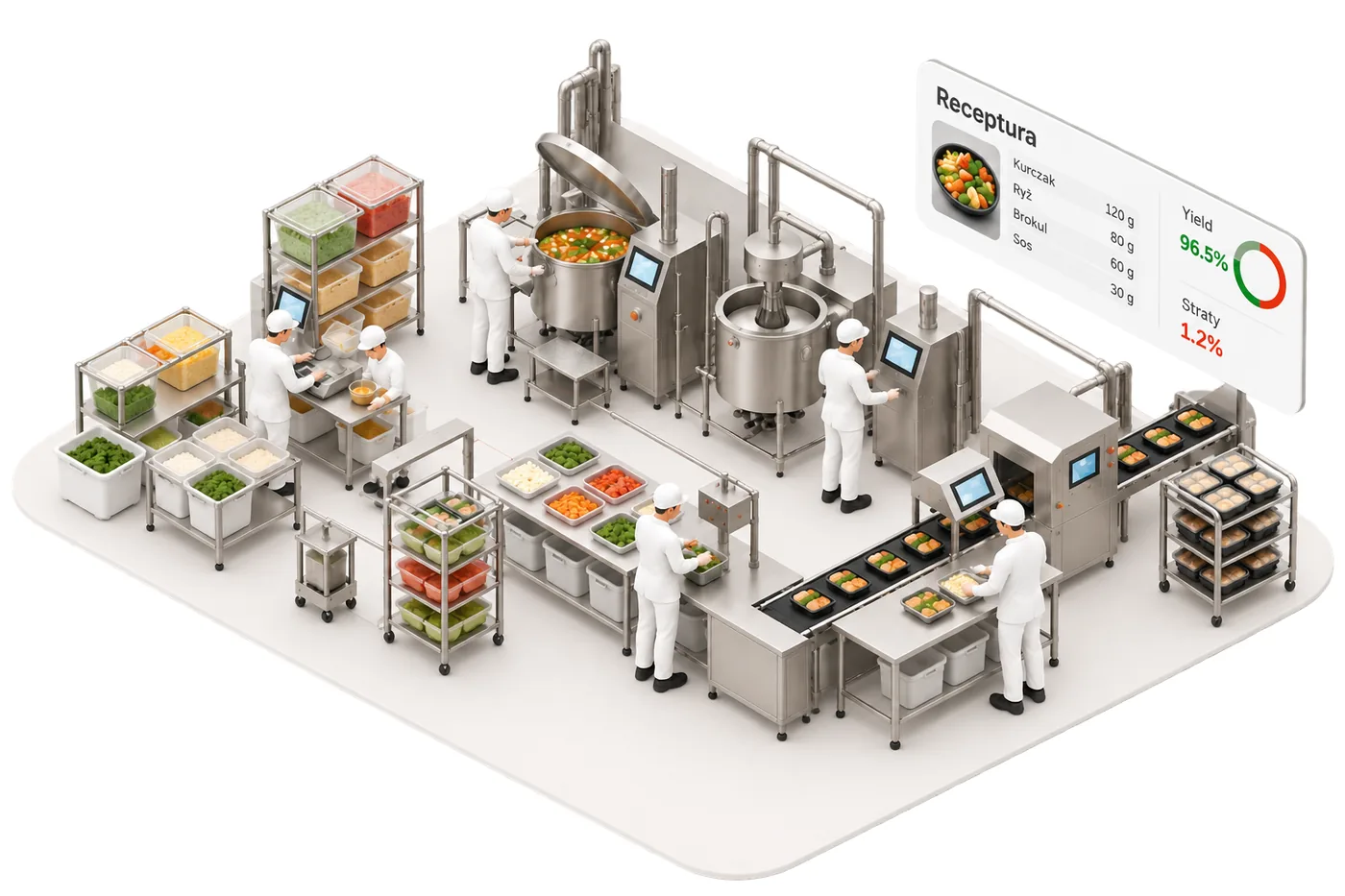
Advanced Recipe Engine: The recipe as a digital model of the production technology
At Rekeep's scale the recipe is the basis of food cost, clinical nutrition, material requirements, purchasing and production planning. Rekeep needed one standardized model for designing recipes and technology that every downstream process could rely on.
Problem
The previous approach did not reproduce the full production process, least of all the losses and yield changes at cleaning, processing, cutting, cooking, chilling and portioning. A kilogram of raw material is not a kilogram of product, so requirements, food cost, warehouse issues and the plan-versus-actual comparison all came out wrong.
Analysis and mapping
We mapped the real production process, not just what a dish consists of, but how it actually comes about: raw material, operation, change in weight and yield, semi-finished item, next step, finished good. We tied the recipe to production schemes and work centers.
What we built for Rekeep
Advanced Recipe Engine with nested recipes and semi-finished items
Yield & Loss Engine covering every stage of the process
Production Schemes tying a recipe to its sequence of operations and work centers
Automatic recalculation of nutrition values and allergens
Recipe versioning with impact analysis: where it is used and what a change affects
Alternative ingredients compared on nutrition, allergens, diet fit, technology and cost
An AI Recipe Cost Optimization layer suggesting cheaper ingredients within dietary limits
Result
1
shared recipe model across every site
6
steps of the production process reproduced digitally
7
mechanisms built into the recipe engine
We created a new recipe management standard that is a single source of truth for the whole organization: one recipe set across sites, sharper food cost and data that propagates automatically into planning, purchasing and production.
02
Predictive planning
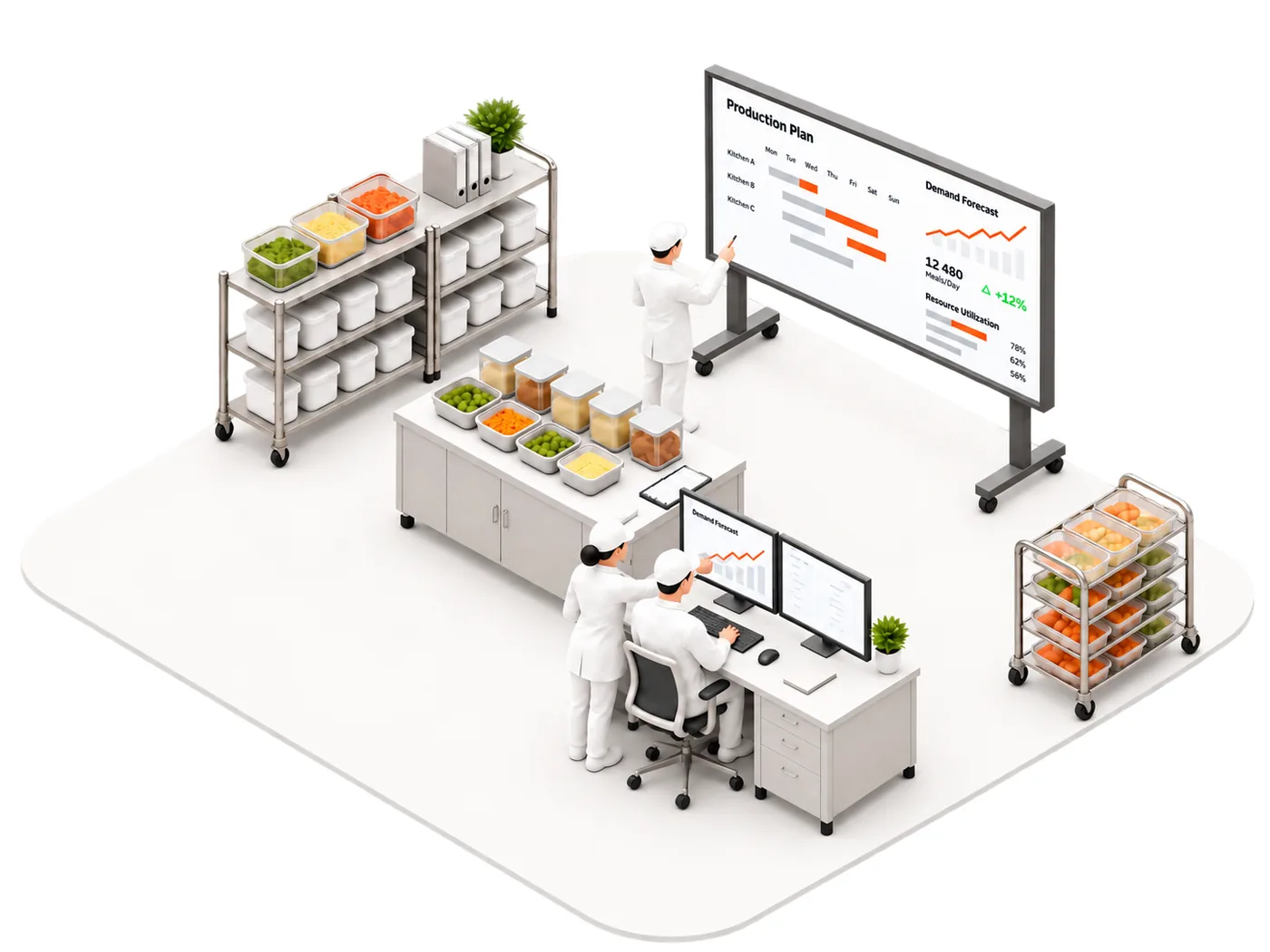
Predictive Layer: Demand and production planning
Rekeep connects information from a large number of hospitals with the capacity of its kitchens and central plants. The first question is how many meals will have to be produced, and only then what, where, when and in what order, across several hundred sites and multiple plants at once.
Problem
Running the process only off firm orders pushes decisions too late. On top of that come swings in patient numbers, diet mix, differences between wards, days of the week, seasonality, holidays and order corrections, and aggregating data from several hundred sites by hand caps how far ahead purchasing and production can be planned.
Analysis and mapping
We mapped the process from the hospital up to the production plant and built a planning module that reproduces the flow: forecast demand, aggregate demand, calculate material requirements, build the production plan, schedule production, monitor execution, replan.
What we built for Rekeep
Hospital Demand Forecast: site-level forecasting before the order cut-off, from patient history and time dependencies
Production Demand Forecast: demand aggregated across diets, meals, dishes, recipes, semi-finished items and raw materials
Fusion- and Transformer-class models compared so the best prediction wins for each data series
Production Planning Engine: plan by work center, production and packing schedule, resource load, simulations and replanning
Result
2
levels of prediction: site and production plant
7
steps from demand forecast to replan in one flow
Fusion / Transformer
model classes compared inside the predictive layer
We moved planning from reactive to predictive, so the organization can prepare for demand before every order is closed, cutting overproduction and shortage risk and planning ingredients earlier.
03
Purchasing
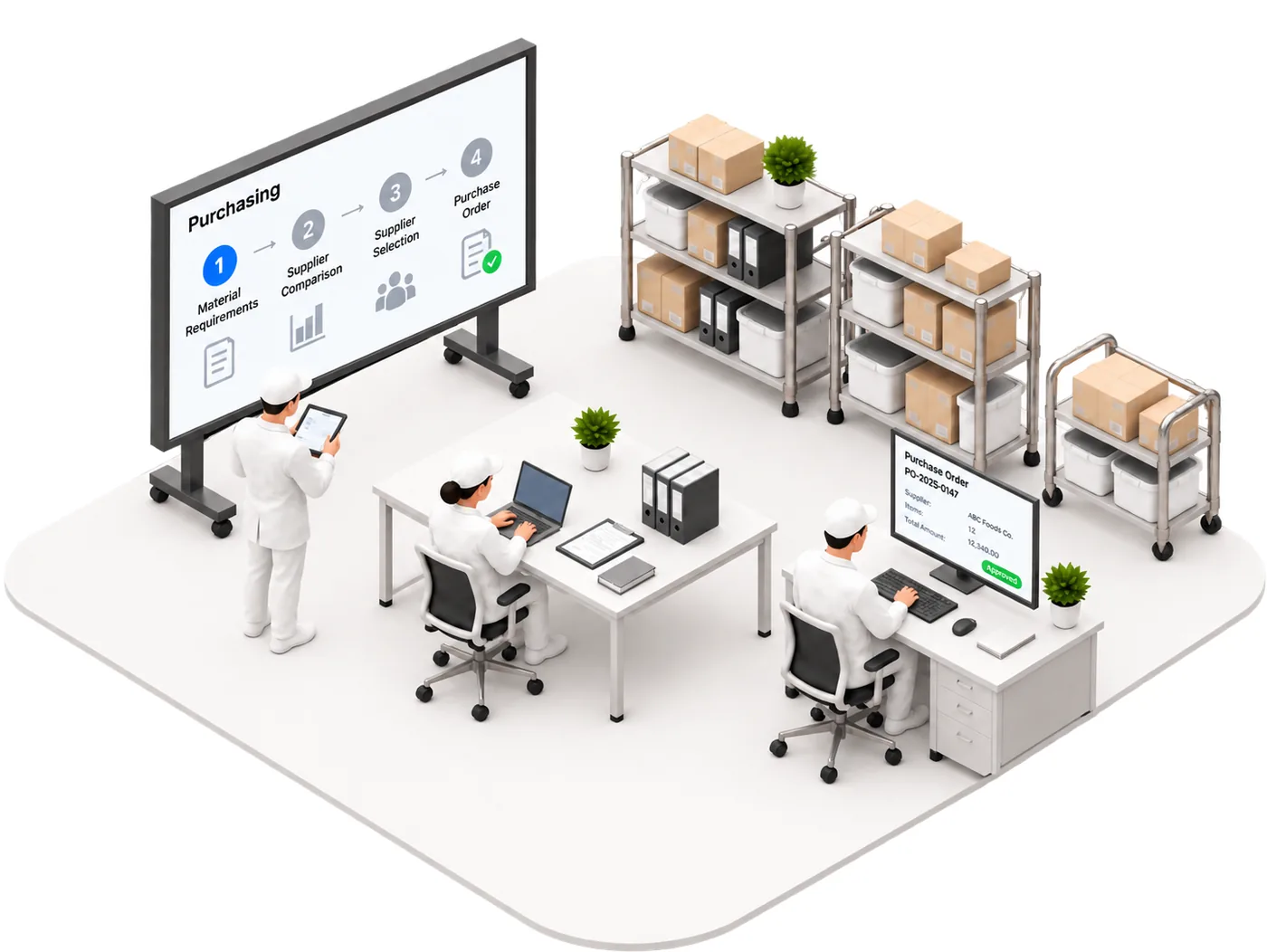
Purchasing System: One purchasing system for the whole organization
The production plan raises the next question: how much of which ingredients to buy, from whom, at what price and by when. At Rekeep's scale purchasing is one of the biggest sources of both savings and uncontrolled cost. It should be an automatic consequence of what the organization intends to produce, not another place to type orders in by hand.
Problem
No single source of current price lists, supplier knowledge scattered across teams, a large volume of manual operations, no link between the production plan and purchasing, limited price and product comparison, and no unified view of the history with a supplier.
Analysis and mapping
We mapped the full flow: production plan, material requirement, inventory coverage, purchase requirement, supplier selection, purchase order, delivery, receiving, supplier evaluation.
What we built for Rekeep
Automatic Purchase Requirements: the plan resolved through recipes and current inventory into a ready buying list
Supplier 360: a central supplier profile with products, terms, price lists, lead times, minimums, quality and claim history
Dynamic Price Lists: fast price list import and updates with validation and supplier-index mapping
Supplier Integrations: digital data exchange with the largest suppliers, a simplified portal for the smaller ones
Result
9
steps from production plan to supplier evaluation in one process
360°
supplier profile: prices, terms, quality, history
7
fields validated on every supplier price list import
We joined the production requirement and the supplier order into one process, with needs calculated automatically, current prices, a comparable supplier base and a quality history that keeps building.
04
Warehouse and receiving
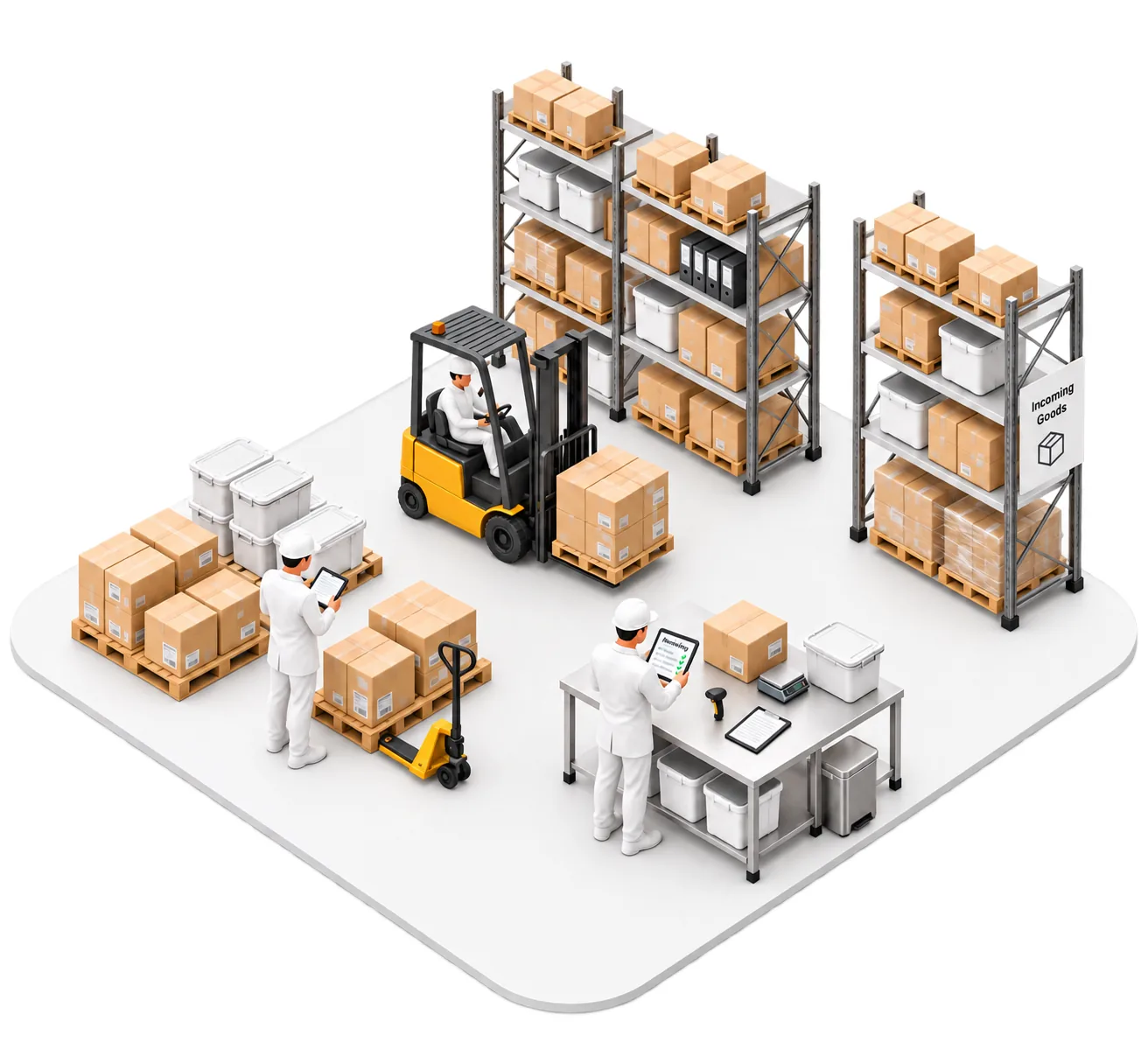
Digital Receiving: Digital control over every delivery
A correct order still does not guarantee cost control. The critical moment is when the goods physically arrive at the plant and someone has to verify that what was ordered actually turned up, in the right quantity, at the right price, quality and time. Receiving is where control over ingredient cost and supplier quality is either established or lost.
Problem
The analysis showed incomplete delivery records and no uniform digital receiving process: a delivery did not always reach the system immediately, there was no full receiving history or consistent quality assessment, and discrepancies were sometimes logged late.
Analysis and mapping
We first straightened out the target process: planned delivery, arrival, document capture, PO matching, quantity check, quality check, lot and expiry registration, accept, partially accept or reject, inventory update, supplier performance data. Only then did we build the software.
What we built for Rekeep
Delivery Schedule: every delivery due on a given day in one view
Digital Receiving on a tablet: full, partial, rejected, split-lot and claimed receipts
OCR Document Capture matching document data against the order
PO vs Delivery Control: shortages, overages, unordered goods, price differences, wrong product, expiry and temperature issues
Supplier Quality Data building a record of compliance, quality and on-time performance
Result
10
receiving steps covered by digital records
OCR
digital processing of delivery documents
7
types of discrepancy detected when matching order against delivery
We turned receiving from a warehouse task into full digital control of order, delivery and ingredient quality, with complete lot traceability and data flowing back to purchasing.
05
Raw material issue
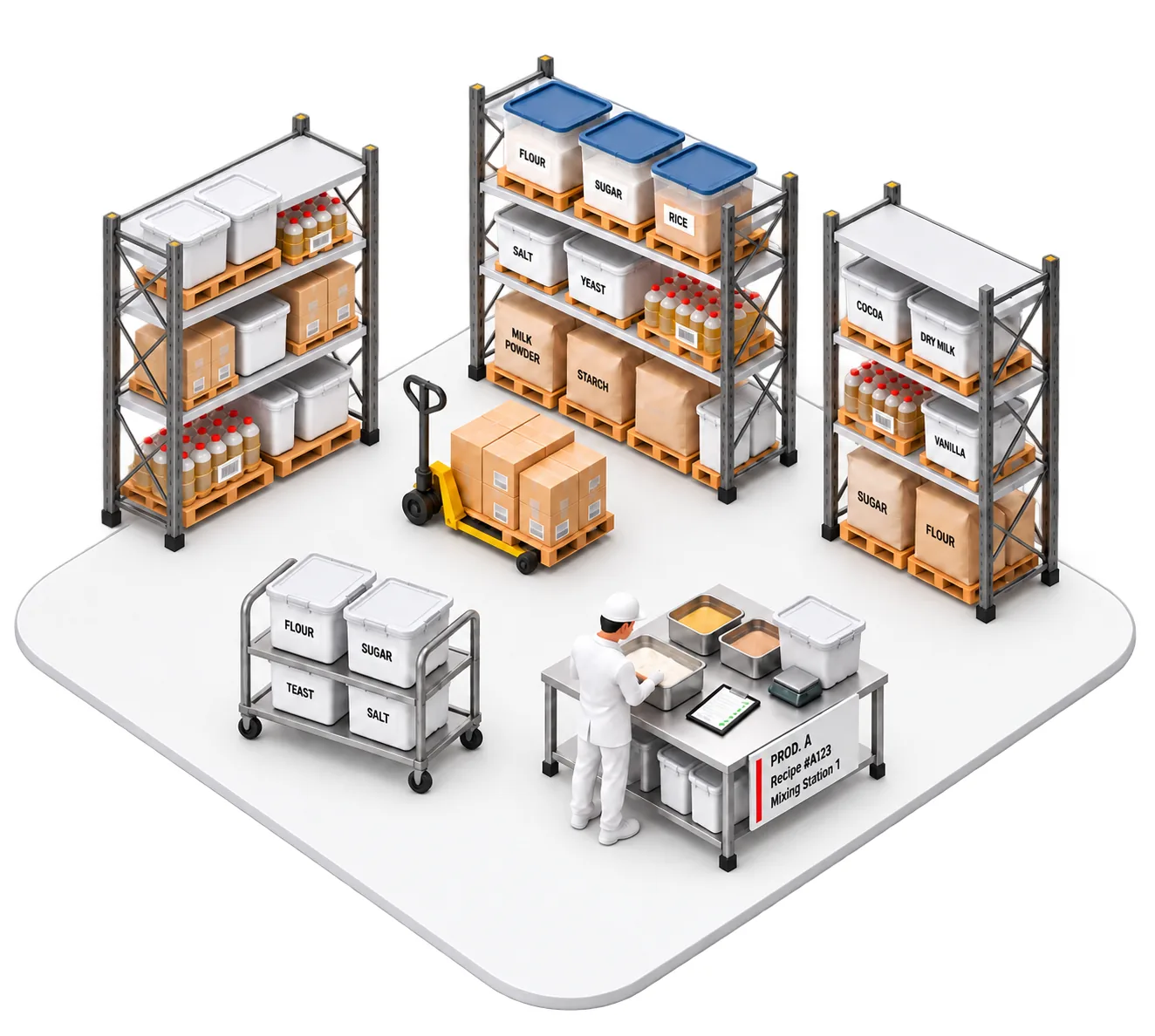
Intelligent Issue Queue: Digital material issues from the warehouse
Correct inventory still does not solve the flow of materials to production. What counts is not only what sits in the warehouse but what should be issued, when, to which station, to which work center and against which recipe, and with many production runs going on at once, managing that by hand means delays, mistakes and lost control over real consumption.
Problem
Without a digital issue process it is hard to say which material should go out next, in what quantity, to which work center and station, for which recipe, when and by whom. Material issued too early takes up space on the floor, issued too late it stops production, and issues logged after the fact strip inventory of its credibility.
Analysis and mapping
We connected warehouse logic straight to production planning: production forecast, production plan, recipe schedule, material requirement, issue schedule. An issue stops being an independent warehouse task and becomes part of the production plan.
What we built for Rekeep
Intelligent Issue Queue: an ordered issue timeline with time, material, quantity, location, work center, station, recipe and order
Mobile Warehouse Tablets: issues completed on a handheld, from opening to pick confirmation and close
Real-Time Inventory Update feeding production, planning, purchasing and controlling instantly
Digital Internal Documents giving every movement a full trail
Additional Material Requests turning a shortage call from the floor into a warehouse task rather than a phone call
Result
8
data points describe every issue in the queue, from time to work order
Real-time
inventory updated after every operation
0
parallel paper issue documents
We turned a warehouse issue from a reactive task into a scheduled part of production, queued against real production needs, with fewer stoppages, no paper documents and a full audit of material flow.
06
Production and MES
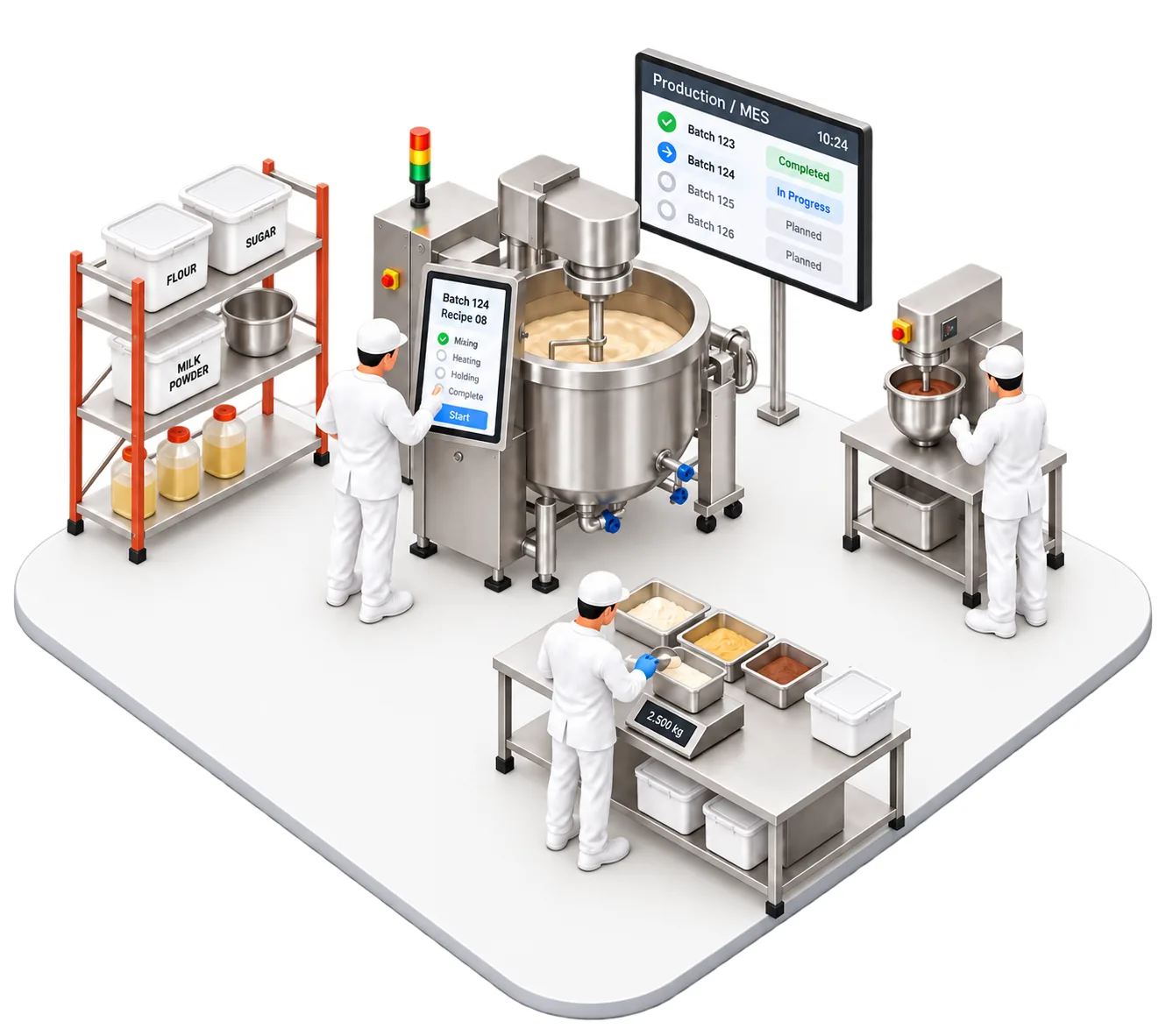
Live Production Control: Full digital production execution
Once the plan is set and the materials are delivered, physical production begins. Rekeep needed a system that walks operators through the plan and gives the manager full visibility of the floor: one environment connecting plan, work center, operator, recipe, material, time, yield, loss and the finished result.
Problem
Without a digital MES a production manager cannot tell which recipe has started, at which work center, how far it has got, whether the operator has every ingredient, how long an operation takes, how much product was actually made or how much material was lost. Operators, meanwhile, need current instructions and tools that spare them recalculating recipes by hand.
Analysis and mapping
We mapped the real life of a recipe on the floor: materials available, operation start, instructions followed, time recorded, weighing, step closed, handover to the next work center, final yield. Every recipe was tied to the plan, work centers, stations, operators, materials, operation times and expected yield.
What we built for Rekeep
Live Production Control: the status of every recipe at every work center in real time, with progress and delay risk
Digital Work Instructions on tablets with recipe, materials, quantities and operation order
Material Readiness Check before a recipe starts
Start/Stop Tracking recording actual time, operator, station and work center
Smart Production Calculator that scales a recipe in both directions
Additional Material Request raised from the tablet
Weight & Yield Registration comparing actual against expected weight at every step
Full Production Traceability: who, what, where, when, how much, from which material and with what result
Result
Real-time
status of every recipe at every work center
8
MES mechanisms built for the production floor
100%
of operations covered by time and yield capture
We moved production from a plan plus manual reporting to full digital execution and live monitoring, with real operation times, work center performance data and yield at every step.
07
Continuous learning
Prediction Feedback Loop: Production as the data source for prediction
Executing production is not the last step in the process. It is at the same time the source of new data for the next plans and forecasts. The system was built on the premise that every production day yields data that can improve the next one.
Problem
A forecast and a schedule are only as good as the data behind them. A system that knows only theoretical values cannot say how long a recipe really takes, what the actual yield is, where the biggest losses arise, which work centers run faster or how often a replan is needed.
Analysis and mapping
We treated every production operation as a data point. The system compiles forecast against actual: planned and real start, finish, operation time, yield, consumption and volume.
What we built for Rekeep
Forecast vs Actual, compiled automatically once production closes
Historical Production Data at recipe, work center, station, shift, operator, day and plant level
Prediction Feedback Loop returning actuals to planning and prediction, closing the loop
Process Intelligence spotting repeat delays, underestimated times, yield variance, problem recipes and overloaded work centers
Result
6
dimensions comparing plan against execution
7
aggregation levels of historical production data
Feedback loop
closing forecast and execution
We made production do more than execute the plan: it teaches the system how to build a better one tomorrow, steadily improving the forecast, the schedule, material requirements, resource planning and loss control.
08
Packing
Intelligent Packing Schedule: Intelligent scheduling and digital execution of packing
In hospital foodservice packing is a critical stage: sequence, portion weights, pack type, the layout of the components, consistency with diet and recipe and correct labeling all have to hold. With that many diets, dishes and variants, managing the packing order by hand raises the risk of errors and stoppages.
Problem
Without a digital module it is hard to hold the optimal packing sequence, stay aligned with the plan, repeat portion weights, place components correctly, give operators unambiguous instructions, control operation time and trace the finished product, all at once.
Analysis and mapping
We connected packing straight to the production plan and the real execution status of recipes: what is ready, what should be packed, in what order, into which pack, at what portion weight and under which label.
What we built for Rekeep
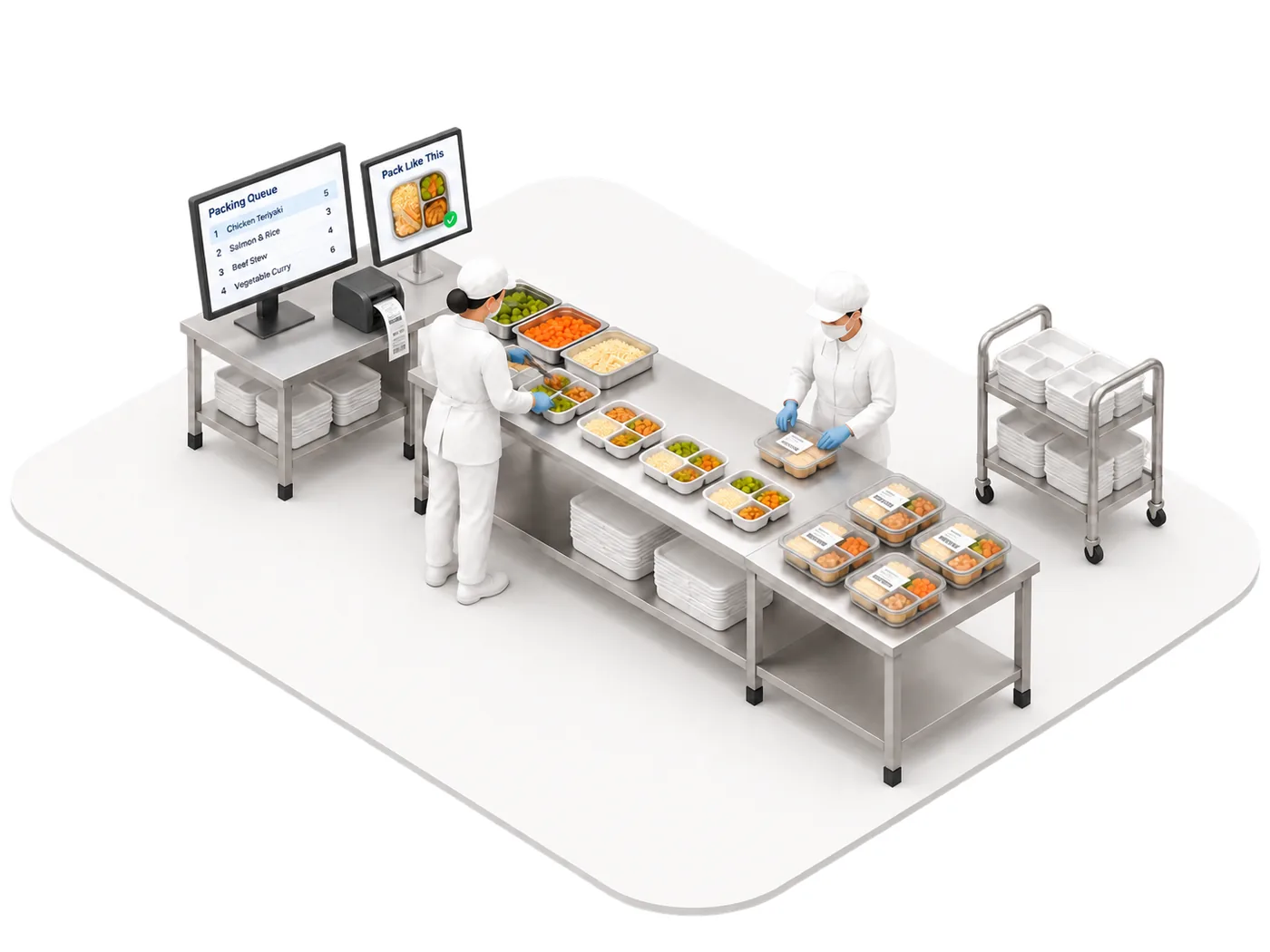
Intelligent Packing Schedule prompting what to pack and in what order, updating as production progresses
Start/Stop Packing recording actual operation time
Digital Packing Instructions with portion weight, pack type, tray compartment and layout order
Visual Reference: a photo of the correctly packed product
Smart Label Management for single packs, trays, bags and cases tied to a lot
Packing Traceability recording recipe, lot, operator, station, times and pack type
Result
6
mechanisms built into the packing module
4
pack types handled by the labeling system
Visual reference
the packing standard at every station
We moved packing from manual organization to an intelligently queued, digitally guided process, with repeatable portion weights, one consistent product presentation and automatic labeling.
09
Data and analytics
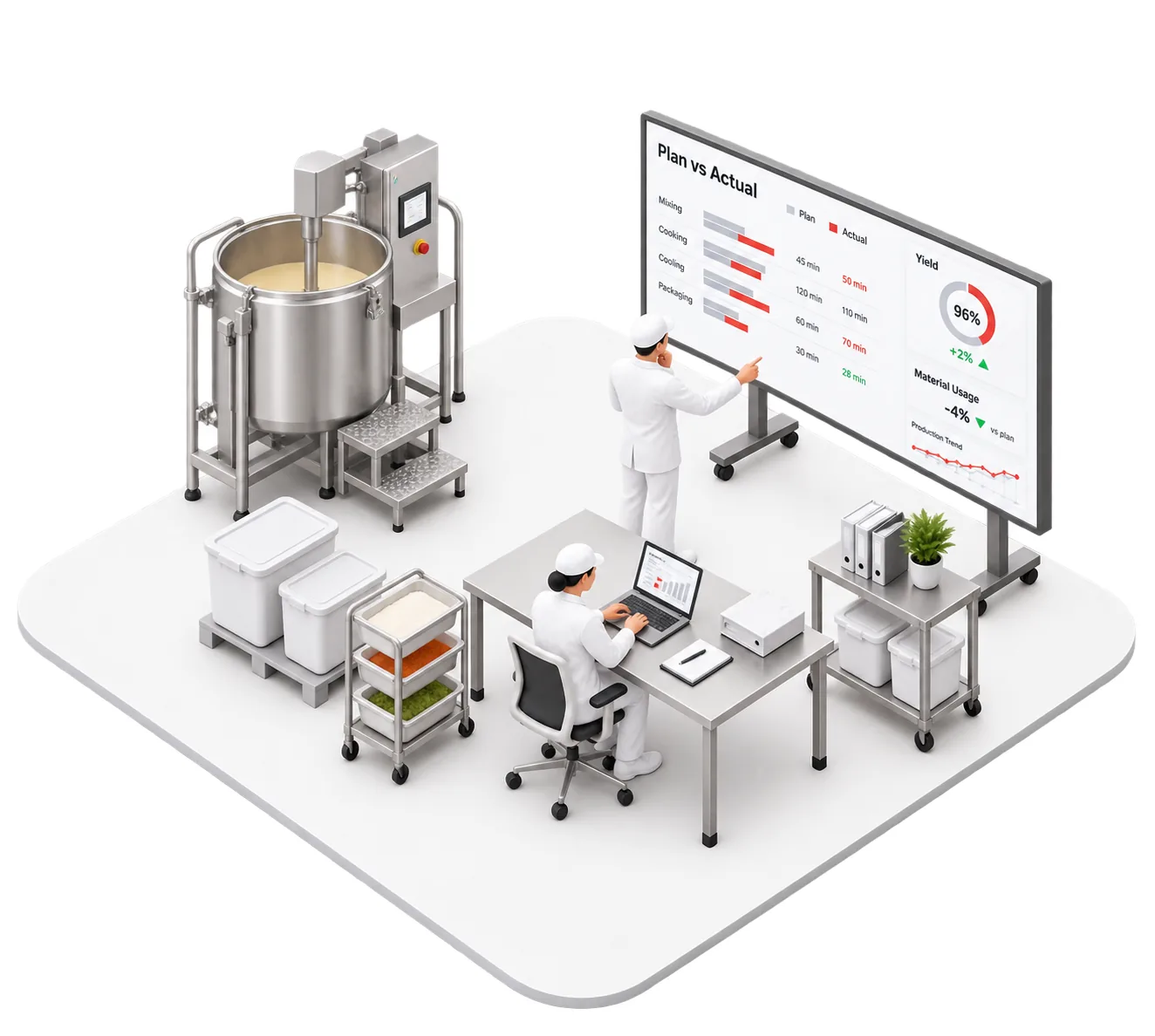
Management Dashboards: One data layer for the whole process
The greatest value of digitization appears when data from recipes, the warehouse, production and packing is analyzed together. No module is a separate application: each one feeds a shared data layer. Rekeep needed an answer to one question: what happened to the cost, the ingredient and the recipe, from plan all the way to finished product.
Problem
In a scattered environment data answers only local questions: the warehouse knows what it issued, production knows what it made, packing knows what it packed and purchasing knows what it ordered. The picture of the whole process is missing.
Analysis and mapping
We connected data across the chain (recipe, forecast, purchasing, receiving, warehouse, issue, production, packing) so the process can be analyzed end to end.
What we built for Rekeep
Plan vs Actual across every step of the process
Yield Analytics at recipe, step, work center and plant level
Production Time Analytics
Material Consumption Analytics
Packing Performance
Supplier quality data tied to how material was actually used
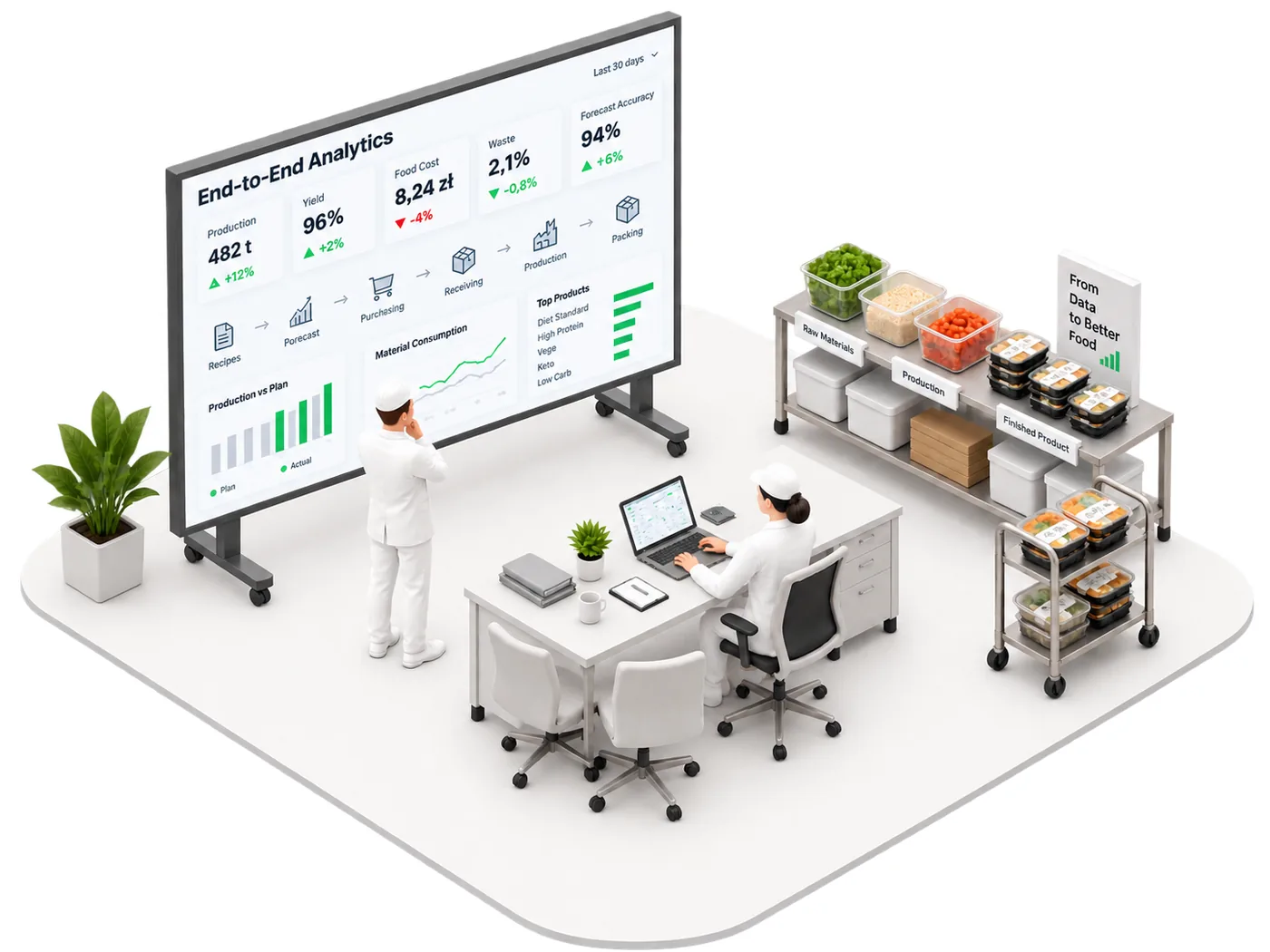
Management Dashboards for managers and the board: production, food cost, variances, waste, consumption, forecast accuracy and process performance
Result
8
process steps connected in one data layer
6
analytical areas feeding the dashboards
End-to-end
cost tracking from plan to finished product
We gave Rekeep one data environment that moves it from reporting on individual operations to managing the whole process on real end-to-end data.
The connected flow
Connected Food Operations System
We built the greatest value of this project not in any single module but in the way they connect. Every step works on data the previous one created, and actuals return to the forecast to improve the next plans.
Planning
01Recipe
02Demand forecast
03Production plan
04Material requirement
Supply
05Purchasing
06Supplier
07Delivery
08Warehouse
Execution
09Raw material issue
10Production and MES
11Packing
12Data and analytics
Optimization loop
13Better forecast
Actuals return to the forecast and raise the accuracy of the next planning cycle.
The change we built
Eight shiftsthat define the project
Before
After
A recipe as a list of ingredients
A recipe as a digital model of production technology and cost
Reactive planning based on firm orders
Predictive planning that starts before the order cut-off
Purchasing as orders typed in by hand
Purchasing as an automatic consequence of the production plan
Receiving as a warehouse task
Full digital control of order, delivery and quality
The warehouse issues material on request
The system schedules issues against the production plan
Production reported by hand after the fact
Digital execution and live production monitoring
Packing organized by hand
An intelligently queued, digitally guided packing process
Reporting on individual operations
Managing the whole process on end-to-end data
Note
We built and adapted every module described here to Rekeep's processes, on the basis of the analysis and mapping that preceded it. Specific KPIs and financial results will be added once the client confirms the data.
Build the connected operating system for your organization.
The next step starts the same way it did at Rekeep, with analyzing and mapping your processes.